Creatures & Robots
In body-control tasks the circuit decides at every step “which joint to move, and which way”. Nothing moves forward until the circuit discovers a periodic gait on its own, so this is a step harder than games.
A bug starts walking
Section titled “A bug starts walking”A planar bug with two legs, each with two joints. The physics is our own, with no external engine. A circuit of 32 two-input gates started walking after just 4 generations and 22 seconds of evolution.
We also evolved classic NEAT with real-valued weights (NN) on the same task. It used 16 parameters and covered 21.1. The speeds are about the same.
Converted roughly into “how many two-input lookup tables (LUTs)”, the sizes are 32 versus 1024 (a coarse estimate that counts one weight as one 8-bit multiply-accumulate; it is not a synthesized circuit area). Walking emerged in 1 of 2 runs; depending on the initial seed, evolution can end without a gait.
A snake-like robot swims
Section titled “A snake-like robot swims”MuJoCo’s Swimmer: a snake-like body of linked segments that only moves forward if it sends a wave down its body. A 37-gate circuit made that wave and moved about 5 m in 400 steps.
Averaged over two runs each, the fitness was 115.4 for the logic circuit and 129.7 for the NN: the NN is slightly ahead. This environment varies little across seeds (within ±8%), so the gap is reliable.
HalfCheetah’s two-state gallop
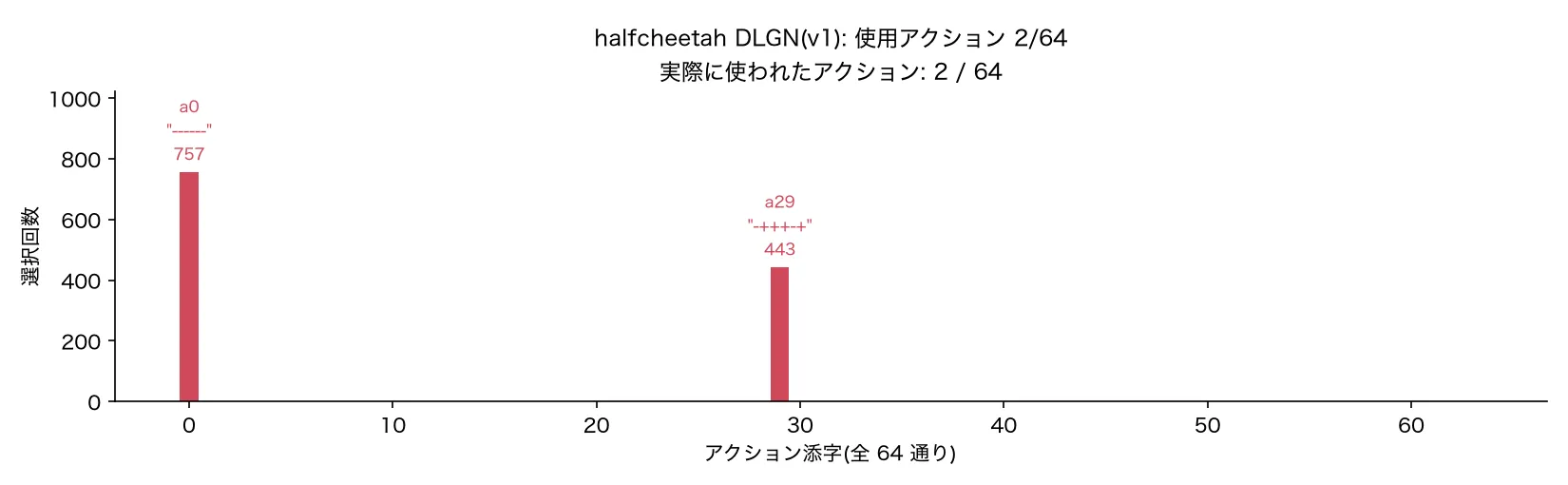
Section titled “HalfCheetah’s two-state gallop”A planar cheetah with six joints. Driving each joint fully one way or the other gives 64 possible moves. The circuit evolution found uses only 2 of the 64.

- It picks “bend all joints” on 63% of steps and “bend the back, extend the front leg” on 37%
- Only 8 gates decide between the two, and just 3 live logic terms drive the switch
- The circuit has no memory and no internal oscillator. The periodic gait comes from the closed loop “circuit → body → sensors → circuit”
- It covers 43.8 m per 1000 steps. An independent re-run of evolution under different settings rediscovered the same 3 terms
An even faster runner was found as well.
On score, though, the NN is ahead: averaged over two runs each, NN 791.0 versus logic circuit 500.9. The circuit is also bigger: giving each of the 64 moves 4 votes makes 256 gates, more than the NN’s 137 parameters. The highlight of this environment is not the score but that a human can read the circuit.
Bipedal walking: forward with 48 LUTs
Section titled “Bipedal walking: forward with 48 LUTs”BipedalWalker. The four joint torques are continuous, but we reduced each joint to “positive or negative”, giving 16 moves. Even so, a circuit of 48 two-input LUTs learned a gait that moves forward.
Averaged over 30 fixed initial conditions, it scored +3.67, far above the -109.55 of random actions. The NN solved the same task with 36 parameters. Generations to solve: 28 for the NN, 41 for the logic circuit.
Hopper, Ant, Humanoid: not walking yet
Section titled “Hopper, Ant, Humanoid: not walking yet”The harder the 3D body, the fewer results we can call “it moves”.
Hopper (hopping on one leg)
Section titled “Hopper (hopping on one leg)”Most of Hopper’s score is a reward for staying upright, so standing still without falling already scores well. The logic circuit fell into this trap and moved only 0.8-1.5 m in 1000 steps. One NN run found an individual that hops forward and never falls (4.4 m).
Ant (quadruped)
Section titled “Ant (quadruped)”Choosing a combination of all 8 joints with a single output made it fall almost immediately. After switching to outputs that choose “positive, negative, or stop” per joint, the logic circuit stayed upright for up to 90% of a 400-step episode. Forward progress was only 0.24-0.61 m, though, and it does not even reach the score of the “stop every joint and do nothing” policy.
Humanoid
Section titled “Humanoid”With 17 joints, choosing joint combinations with one output means more than 130,000 outputs, which cannot be built. With per-joint outputs it runs with 136 gates, and the time before falling grew from 19 steps to 95-114 steps. It does not walk, though. It only sways between -0.47 and +0.23 m.
Indirect encoding (HyperNEAT) lost badly
Section titled “Indirect encoding (HyperNEAT) lost badly”Instead of evolving the circuit gate by gate, we also tried HyperNEAT, which evolves a function that draws the wiring from coordinates. It produced neatly symmetric structures, but on results it lost badly to direct evolution.
- Bug walker: direct evolution solved it in 4 generations (logic circuit) and 6 (NN); HyperNEAT did not solve it in any run within 100 generations
- Ant: all 4 runs settled on “stop every joint and stand still”, and lost to direct evolution on distance covered